Art
There’s bound to be something on this list for everyone. So pick a book to sit back, relax and enjoy.

A Year with Wendy Whiteley is the story of an incredible woman who was so much more than the cool girl hanging out with the bad boy. She is a hypnotic artist, who was able to give full expression to her own creativity when she came out from under the shadow of Brett and into the sunshine of her own secret garden.
Wendy is a survivor- of drug dependence, bitter divorce, the deaths of Brett and their beloved daughter, Arkie. More than that, she is a remarkable figure whose life has had its own contours and priorities. Now in her early eighties-reflective yet outspoken, with a dry wit-she has much to tell about it.
The product of many hours of candid conversations at the kitchen table in Lavender Bay with acclaimed Brett Whiteley biographer Ashleigh Wilson, and supplemented by extensive research and interviews with others, this is the unforgettable story of Wendy’s life.
~
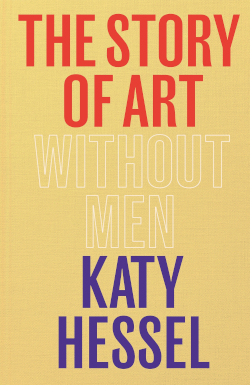
The story of art as it’s never been told before.
How many women artists do you know? Who makes art history? Did women even work as artists before the twentieth century? And what is the Baroque anyway?
Discover the glittering Sofonisba Anguissola of the Renaissance, the radical work of Harriet Powers in the nineteenth-century USA and the artist who really invented the Readymade. Explore the Dutch Golden Age, the astonishing work of post-War artists in Latin America and the women artists defining art in the 2020s. Have your sense of art history overturned, and your eyes opened to many art forms often overlooked or dismissed. From the Cornish coast to Manhattan, Nigeria to Japan, this is the history of art as it’s never been told before.
~

The Aboriginal artist Mick Namarari Tjapaltjarri (c1923-1998) was ‘one of the pillars of contemporary art practice’ (Hetti Perkins, Art Gallery NSW). This ground-breaking account is the first published biography of any Pintupi individual. Two questions are central: how are we to understand Tjapaltjarri, and, what can we learn from him?
Comprehending his life pivots on three Pintupi concepts: tjukurrpa, walytja and ngurra, understood broadly as Dreamtime, family and place. Tjapaltjarri is a worthy biographical subject. He won the National Aboriginal Art Award, the Alice Prize and Australia’s prestigious Red Ochre Award- the only artist to receive all three awards. The Master from Marnpi follows Tjapaltjarri as a child, survivor, stockman, traveller, artist, family leader, cultural advocate and community member, through the life stages of boy, adult and old man.
~

This richly layered compilation invites the reader into the creative spaces of 32 female artists, offering an intimate look behind the scenes and the chance to meet each artist on home ground. Featuring profiles on their practice and process, along with a candid Q&A section, they engage in an honest discussion about womanhood, career, gender inequality and the constant juggle of balancing a contemporary practice with everyday life.
~
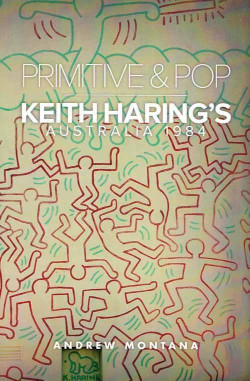
Keith Haring is a world-renowned graffiti artist and his clean, graphic and totemic images appear on everything from subways in New York to museums in Melbourne. Keith Haring travelled extensively and at the height of his fame, he visited Australia in 1984. Melding new scholarship on the visual arts of the early 1980s, this book vividly weaves Haring’s animated art with the audacious work of Australian artists into a forceful, urban cultural history.
~
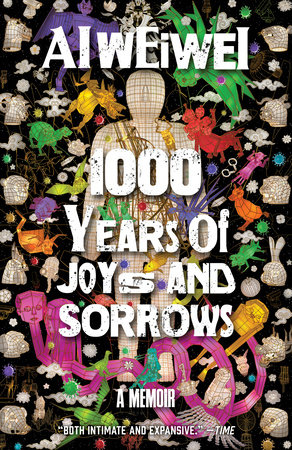
Ai Weiwei recounts his childhood in exile, and his difficult decision to leave his family to study art in America, where he befriended Allen Ginsberg and was inspired by Andy Warhol and the artworks of Marcel Duchamp. With candor and wit, he details his return to China and his rise from artistic unknown to art world superstar and international human rights activist—and how his work has been shaped by living under a totalitarian regime.
At once ambitious and intimate, Ai Weiwei’s 1000 Years of Joys and Sorrows offers a deep understanding of the myriad forces that have shaped modern China, and serves as a timely reminder of the urgent need to protect freedom of expression.
~

In Creatives for Creativity Steve Brouwers (creative director at SBS) interviews 44 makers – painters, photographers, graphic designers, conceptual artists, furniture designers, video artists, advertisers – from all around the world. He asks them about their childhood, their creative process, their inspirations and their most memorable achievements. The question that kicks off every interview – “What is creativity to you?” – results in an inspiring collection of personal conversations that provide an extraordinary insight into the artists’ minds.
~
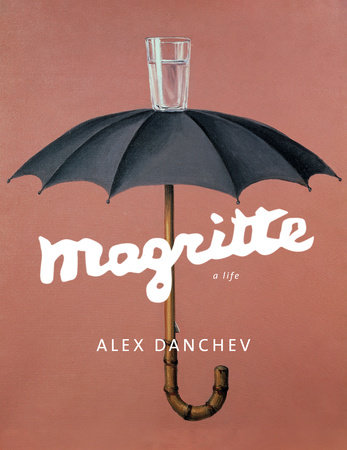
The first major biography of the pathbreaking, perpetually influential surrealist artist and iconoclast whose inspiration can be seen in everyone from Jasper Johns to Beyoncé—by the celebrated biographer of Cézanne and Braque.
In this thought-provoking life of René Magritte (1898-1967), Alex Danchev makes a compelling case for Magritte as the single most significant purveyor of images to the modern world. Magritte’s surreal sensibility, deadpan melodrama, and fine-tuned outrageousness have become an inescapable part of our visual landscape.
Danchev explores the path of this highly unconventional artist from his middle-class Belgian beginnings to the years during which he led a small, brilliant band of surrealists (and famously clashed with André Breton) to his first major retrospective, which traveled to the United States in 1965 and gave rise to his international reputation.
~

Censored Art Today is an accessible, informed analysis of the debates raging around censorship of art and so-called ‘cancel culture,’ focusing on who the censors are and why they are clamping down on forms of artistic expression worldwide.
Art censorship is a centuries-old issue which appears to be on the rise in the 21st century—why is this the case? Gareth Harris expertly analyses the different contexts in which artists, museums, and curators face restrictions today, investigating political censorship in China, Cuba, and the Middle East; the suppression of LGBTQ+ artists in ‘illiberal democracies’; the algorithms policing art online; Western museums and ‘cancel culture’; and the narratives around ‘problematic’ monuments.
~

Hilma af Klint was a Swedish artist and mystic whose paintings are considered among the first abstract works known in Western art history. A considerable body of her work predates the first purely abstract compositions by Kandinsky, Malevich and Mondrian.
Despite her enormous popularity, there has not yet been a biography of af Klint—until now. Inspired by her first encounter with the artist’s work in 2008, Julia Voss set out to learn Swedish and research af Klint’s life—not only who the artist was but what drove and inspired her. The result is a fascinating biography of an artist who is as great as she is enigmatic.
~

In What Artists Wear, style luminary Charlie Porter takes us on an invigorating, eye-opening journey through the iconic outfits worn by artists, in the studio, on stage, at work, at home and at play. From Yves Klein’s spotless tailoring to the kaleidoscopic costumes of Yayoi Kusama and Cindy Sherman; from Andy Warhol’s signature denim to Charlotte Prodger’s casualwear, Porter’s roving eye picks out the magical, revealing details in the clothes he encounters, weaving together a new way of understanding artists, and of dressing ourselves.
~
A classic from the leader of the pop art movement and one of the 20th Century’s most notable personalities
In his autobiography, published in 1975, the private Andy Warhol talks about love, sex, food, beauty, fame, work, money, success; about New York and America; about himself – his childhood in McKeesport, Pennsylvania, good times and bad times in the Big Apple, the explosion of his career in the Sixties, and life among celebrities.
~

Art historian Whitney Chadwick’s acclaimed bestselling study challenges the assumption that great women artists are exceptions to the rule who “transcended” their gender to produce major works of art. While introducing some of the many women since the Middle Ages whose contributions to visual culture have often been neglected, Chadwick’s survey reexamines the works themselves and the ways in which they have been perceived as marginal, often in direct reference to gender. In her discussion of feminism and its influence on such a reappraisal, she also addresses the closely related issues of ethnicity, class, and sexuality.
~

 Free delivery Australia wide
 7 Day Satisfaction Guarantee
 Safe & Secure Payments